Category Archives: Uncategorized

Marika Sherwood

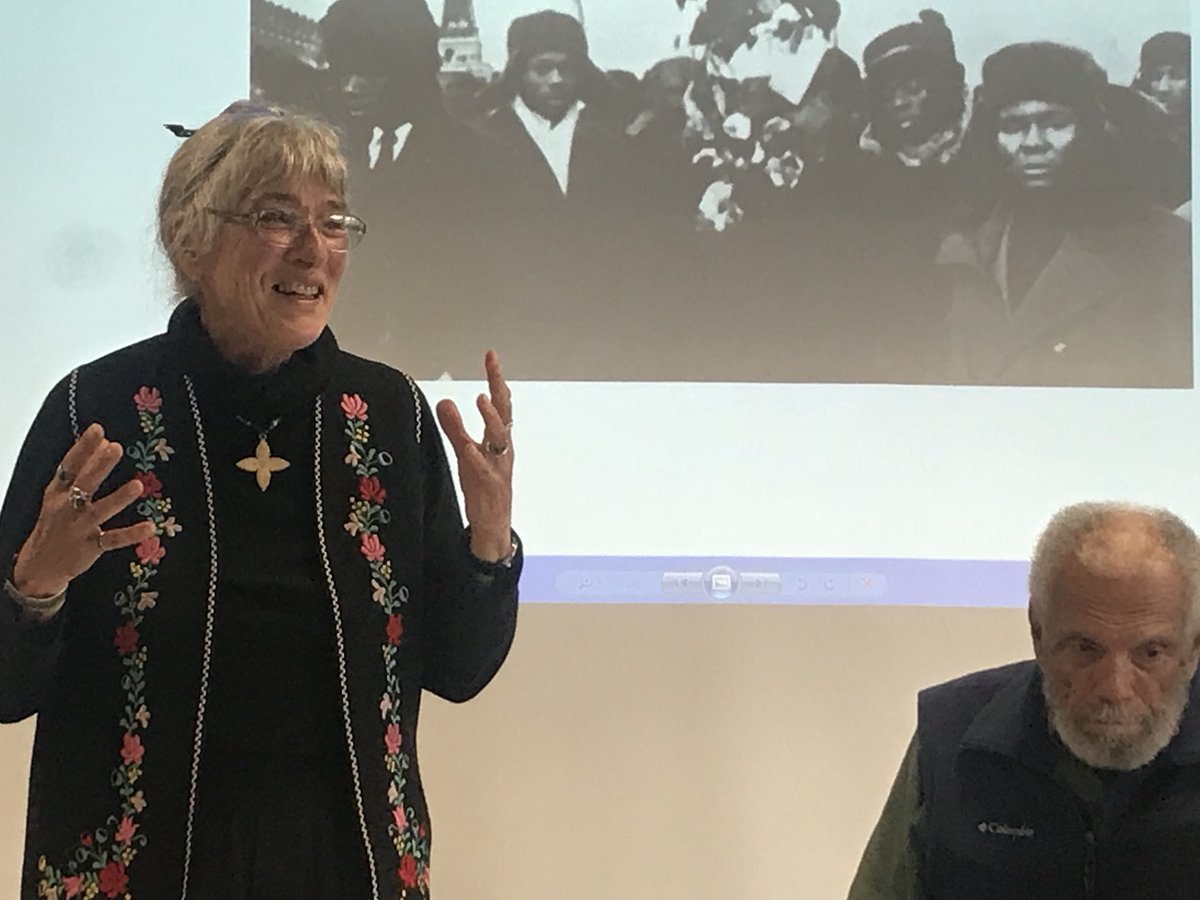
Marika Sherwood speaking at The Red and the Black: The Russian Revolution and the Black Atlantic conference held at UCLAN’s Institute for Black Atlantic Research in 2017

[Personally I owe a great debt to Marika Sherwood, who sadly died at her home in Oare on 16 February 2025 aged 87, as she was a pioneering and legendary researcher of the African diaspora in general and of Black British history in particular – but also incredibly supportive of my own historical work on C.L.R. James and Pan-Africanism and generous in sharing her own personal archive with me. I wrote a short obituary of Marika for Socialist Worker and the Faversham Society newsletter – below is from the latter – and I also had the great honour of publishing her writing on Pan-Africanism both as part of an edited collection arising from the conference The Red and the Black and when helping edit Leeds African Studies Bulletin].

Marika was born in Hungary in 1937 to a Jewish family, many of whom were killed during the Holocaust, experiences which made her into a lifelong opponent of not just antisemitism but all forms of racism and oppression – including that of the Palestinian people. She emigrated with surviving members of her family to Australia in 1948, and lived for periods in New Guinea, New York and Sicily before ultimately making the UK her home.

During the mid-1960s while working as a teacher in London, Marika saw how institutional racism failed young black boys in particular, and was frustrated by the lack of any black history on the school curriculum. While a supplementary schools movement emerged among the West Indian community in response, Marika began what would become a lifetime project campaigning to introduce the black presence in British history onto the curriculum of schools, colleges and universities.

Her weapons in this struggle were a passionate commitment to anti-racist education, tenacious and tireless skills as a dedicated archival researcher, and the methodology of C.L.R. James, Eric Williams and Walter Rodney. She was not alone in this project – one thinks of the work of Peter Fryer, author of Staying Power for example – and soon found allies when in 1991 she co-founded the Black and Asian Studies Association with Hakim Adi and others, becoming editor of its Newsletter.

Her own research expanded from the West Indian contribution in Britain during the Second World War in Many Struggles (1985), to recovering the history of Pan-Africanism in Britain, and then to the wider global dimensions of black history. One notable intervention came with After Abolition: Britain and the Slave Trade Since 1807 (2007), which drew attention to the huge profits that British merchants and bankers still managed to make from slavery and the slave trade until at least the 1880s. Marika’s discussion of what she called ‘the realities behind the well-promoted image of an altruistic and anti-slavery Britain’ powerfully challenged nationalist mythology during the bicentenary of abolition.

Marika’s brilliance shined particularly brightly in her biographical portraits of black fighters, including neglected aspects of the life and work of Kwame Nkrumah, Claudia Jones and Malcolm X. She also made pathbreaking contributions recovering the lives of a host of little-known figures including the Trinidadian Pan-Africanist Henry Sylvester Williams, the Guyanese labour organiser Ernest Bowen and the Nigerian pastor Daniels Ekarte. After moving to Kent she also began inevitably researching local black history in the county. ‘I did it because the people I spoke with seemed to think that there had never been black families living in East Kent, but when I researched it I found people from the colonies had settled in the area since the 16th century’ she later recalled. In 2012 she published Albert Makaula-White, an African Farmer in Kent 1904–1937, following this up with her last work, published earlier this year, An African Family in Kent: The African Makaula-White Family in East Kent.

Her own comradeship with figures like C.L.R. James and Peter Blackman – as well as her own socialist politics, shaped by the Hungarian Revolution of 1956 – meant her writings were passionate and often polemical pieces designed to educate and inspire action. Indeed, and perhaps most remarkably of all, she managed everything with limited institutional support, a senior research fellowship at the Institute of Commonwealth Studies in London. The reputation and respect she established worldwide as a leading authority on Black British History and as a profoundly kind and generous mentor who encouraged and supported so many younger researchers in this field meant she was rightly honoured in 2022 with an honorary doctorate from the University of Chichester.

Marika leaves an extraordinary and inspiring legacy of scholarship and activism – condolences, sympathy and solidarity to her son Craig and her wider family.

Below is a link to the fine memorial event to Marika held at the CLR James Library in Dalston, Hackney in April 2025 – the event starts about 15 minutes in.

Leave a comment

Filed under Uncategorized

Plaque to commemorate James Baldwin’s visit to the CLR James Library in Hackney to be unveiled

Exciting news:

‘James Baldwin author, poet and activist is a legendary figure in literature and US Civil Rights history. He marched with Martin Luther King and Malcolm X, debated at Cambridge, argued with US presidents and gave incredible speeches. He spent a great deal of time in London and often lent his status to support local anti-racist campaigners.

The 18th May 1953, is when Baldwins first book ‘Go Tell it on the Mountain’ was published. That book launched his stellar career where he produced classics like the Fire Next Time,If Beale Street could Talk and Notes of a Native Son etc.

In July 1985, Baldwin visited the CLR James library in Hackney. Hackney council had declared 1985 a Year of Anti-Racism. The library had been re-named after the Pan-Africanist historian and author of the revolutionary ‘Black Jacobins’, CLR James, due to intense activism by local anti-racist groups.

In the early 1980s the Hackney Ethnic Minorities Library Consultative Committee had picketed offices, occupied the Town Hall, lobbied, campaigned and successfully got the libraries to stock Black history books and remove racist literature.

On the Friday 17th May 10am 2024 we will unveil a Nubian Jak Blue Plaque to recognise Baldwin’s presence and the link to Black British Civil rights.’

Leave a comment

Filed under Uncategorized

C.L.R. James’s play Toussaint Louverture now a graphic novel!

Thanks to the amazing work over a decade by Nic Watts and Sakina Karimjee, C.L.R. James’s play Toussaint Louverture is now a remarkable graphic novel out now with Verso – check it out!

Leave a comment

Filed under Uncategorized

Talk on CLR James in Nelson

The event is 11am, Saturday 24 June at Nelson Library – free entry and no need to book in advance thanks

Leave a comment

June 20, 2023 · 11:53 am

CLR James Plaque in Southwick unveiled

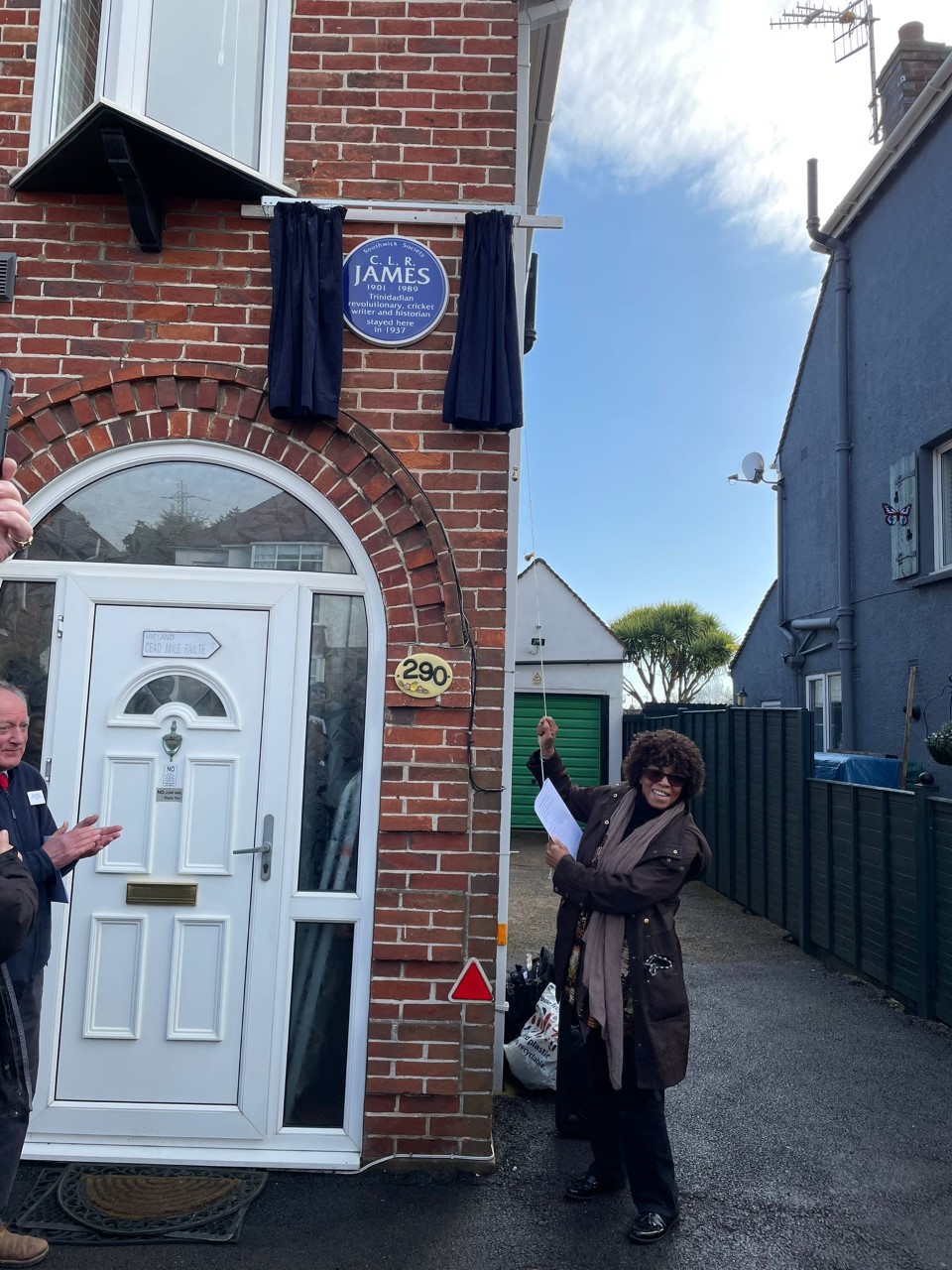
On Friday 17 March, the Southwick Society unveiled a blue plaque to commemorate the late, great black Trinidadian cricket writer and revolutionary historian C.L.R. James (1901-1989) with special guests of honour Leila Hassan Howe, co-founder of the Race Today Collective, and editor and publisher Margaret Busby.  The plaque was possible thanks in part to a letter James wrote from 290 Old Shoreham Road on 19 July 1937 that was intercepted by Special Branch who were monitoring James – like many other activists – for his anti-capitalist and anti-imperialist activism.    In 1937, James was a leading activist in the British Trotskyist movement as well in the Pan-Africanist movement, and was in Southwick (just outside Brighton) that summer writing up what would become his classic history of the Haitian Revolution, The Black Jacobins (1938).   In his preface he described writing the work ‘in the stillness of a seaside suburb’.  The Haitian Revolution of 1791-1804, led by Toussaint Louverture, was the only successful mass slave revolt in human history and saw the birth of the world’s first independent black republic outside of Africa. 

Leave a comment

Filed under Uncategorized

Plagues, vaccines and revolutionaries

I have written a short piece on Plagues, Vaccines and Revolutionaries: When Waldemar Haffkine met Shapurji Saklatvala in Colonial Bombay for the London Socialist Historians Group Newsletter, 72 (Spring 2021) which explores the life of the little known Russian-born bacteriologist Waldemar Haffkine, hailed by Joel Gunter and Vikas Pandey recently on the BBC website as ‘the vaccine pioneer the world forgot’, including his connection to the Indian-born Communist Shapurji Saklatvala, who was elected an MP in Battersea.

Though I am not sure he would have totally appreciated being linked to an article primarily about revolutionary figures such as Haffkine and Saklatvala, I would like to dedicate this piece to the memory of a friend of mine, Ed Rooksby (1975-2021), who I knew while were both Phd students at York University in the mid-2000s, and who tragically, despite being only 46, died of Long Covid at the start of 2021. There is a bibliography of his writings here – https://rooksbyism.wordpress.com/bibliography/ – and my piece in a sense is a belated continuation of a longstanding dialogue between us about reform or revolution – one to which Ed will sadly never be able to respond to. I last saw Ed in about May 2019, when he very kindly (kindness was a characteristic of Ed) put me up in Oxford for a night while I was researching what became the little booklet I co-wrote with Geoff Brown, Apartheid is Not a Game: Remembering the Stop the Seventy Tour (2020). I never thanked him in the acknowledgements to the book – I probably just bought him a pint at the time by way of thanks – so I am recording my thanks here and now. Ed Rooksby’s untimely death – though of course just one of so many tragedies amid Covid – was so unfair on so many levels – not least as he never published his long awaited book Taking Power: Reform, Revolution, Socialist Strategy which would have brought him the audience on the international left that he deserved. Ed Rooksby exemplified some of the best traditions on the Left in his lack of sectarianism, the seriousness of his commitment to politics – and trade unionism, and his very dry wit and humour – and will be widely missed. RIP Comrade Rooksby.

Leave a comment

Filed under Uncategorized

Revolutions and Revisions

I am indebted to Peter Hudson of the excellent resource the Public Archive for interviewing Prof Charles Forsdick and myself about our recent work in the field of Haitian revolutionary studies – you can read the full interview with Charles and myself here

Leave a comment

Filed under Uncategorized

Engels in Eastbourne

Engels-Eastbourne

Engels in Eastbourne
CMNH Conference – originally to be held to mark Engels@200 – – now forthcoming from 1-3 June 2023 at the View Hotel, Eastbourne, for more details see here

Keynote speakers:
Tariq Ali, writer and filmmaker

Helena Sheehan, Professor Emeritus, Dublin City University
Terrell Carver, Professor of Political Theory at the University of Bristol

The original Call for Papers:
28 November 2020 marks the bicentenary of the birth of Friedrich Engels, the German radical philosopher who in works such as The Condition of the Working Class in England (1844), The Peasant War in Germany (1850), The Housing Question (1872), ‘The Part Played by Labour in the Transition from Ape to Man’ (1876), Anti-Dühring (1877), Socialism: Utopian and Scientific (1880), Dialectics of Nature (1883) and The Origin of the Family, Private Property and the State (1884) made pathbreaking and profound contributions to modern social and political theory. As the co-thinker of Karl Marx and co-author of The Communist Manifesto and ‘The German Ideology’, he played a critical role in the forging and development of classical Marxism specifically. But like Marx, Engels was ‘above all a revolutionary’, who also played a role in revolutionary upheavals such as the German Revolution of 1848 and in the international socialist movement.
When Engels died in London on 5 August 1895, at the age of 74, his last wish was that following his cremation his ashes be scattered off Beachy Head, near Eastbourne. Marx and Engels had visited many Victorian seaside resorts, such as Margate, Ramsgate and the Isle of Wight, but Eastbourne was Engels’s favourite place and where he holidayed for extended periods during the summers in later life. Engels wrote to Sorge on 18 March 1893 for example that he had spent two weeks in Eastbourne and ‘had splendid weather’, coming back ‘very refreshed’.
As part of the wider commemorations planned for Engels@200, Engels in Eastbourne welcomes proposals for papers on any aspect of Engels’s life, work and intellectual and political legacy. Themes may then include but are not restricted to the following:
– Engels’s relationship to Marx and Marxism
– Engels’s anti-colonialism and internationalism
– Engels’s understanding of the origins of women’s oppression
– Engels’s analysis of natural science and the natural world
– Engels’s understanding of religion
– Engels’s analysis of capitalism and working class and peasant struggles
– Engels’s concept of ‘social murder’
– Engels’s role in revolutionary movements and relationship to other revolutionaries
– Representations and commemorations of Engels

Our keynote speakers:
Tariq Ali is a writer and filmmaker. He has written more than two dozen books on world history and politics, and seven novels (translated into over a dozen languages) as well as scripts for the stage and screen. He is an editor of New Left Review.

Helena Sheehan is Emeritus Professor at Dublin City University, and has academic interests in philosophy, the history of Marxism and media studies. She is the author of works including Marxism and the Philosophy of Science: A Critical History and Navigating the Zeitgeist: A Story of the Cold War, the New Left, Irish Republicanism, and International Communism

Terrell Carver is Professor of Political Theory at the University of Bristol. He has degrees from Columbia University and the University of Oxford, and has held visiting appointments in the USA, Australia, Japan and China. He has published widely on Marx, Engels and Marxism, including Friedrich Engels: His Life and Thought (being re-issued for a 30th anniversary edition) and his current project is a short book Engels Before Marx coming out in late 2020 as a ‘Palgrave Pivot’.

For more info please contact c.j.bergin@brighton.ac.uk or Christian Høgsbjerg c.hogsbjerg@brighton.ac.uk
Image credit: Marxists Internet Archive
https://www.marxists.org/admin/janitor/faq.htm#images

Conference supported by the Centre for Applied Philosophy, Politics and Ethics and the Centre for Memory, Narrative and Histories at the University of Brighton

Engels in Eastbourne – international conference

Leave a comment

Filed under Uncategorized

Insurgent Empire

Image result for insurgent empire priya gopal
For those of you near Cambridge on Thursday 6 June 2019, this book launch might be of interest:

Join Dr Priyamvada Gopal at Heffers bookshop as she talks about her new book, Insurgent Empire: Anticolonialism and the Making of British Dissent, in conversation with Dr Christian Hogsbjerg. It is a book that reframes the narrative, focussing on how resistance in the colonies changed British ideas of freedom.

Much has been written on how colonial subjects took up British and European ideas and turned them against empire when making claims to freedom and self-determination. The possibility of reverse influence has been largely overlooked. Insurgent Empire shows how Britain’s enslaved and colonial subjects were not merely victims of empire and subsequent beneficiaries of its crises of conscience but also agents whose resistance both contributed to their own liberation and shaped British ideas about freedom and who could be free. This book examines dissent over the question of empire in Britain and shows how it was influenced by rebellions and resistance in the colonies from the West Indies and East Africa to Egypt and India. It also shows how a pivotal role in fomenting dissent was played by anticolonial campaigners based in London, at the heart of the empire.

For tickets and more information please see here

For more information on Priya’s new book please see here – I am delighted to be joining Priya to help launch it in Cambridge on 6 June.

Leave a comment

Filed under Uncategorized

National unity demonstration against fascism and racism in London #N17

Leave a comment

October 24, 2018 · 2:26 pm