
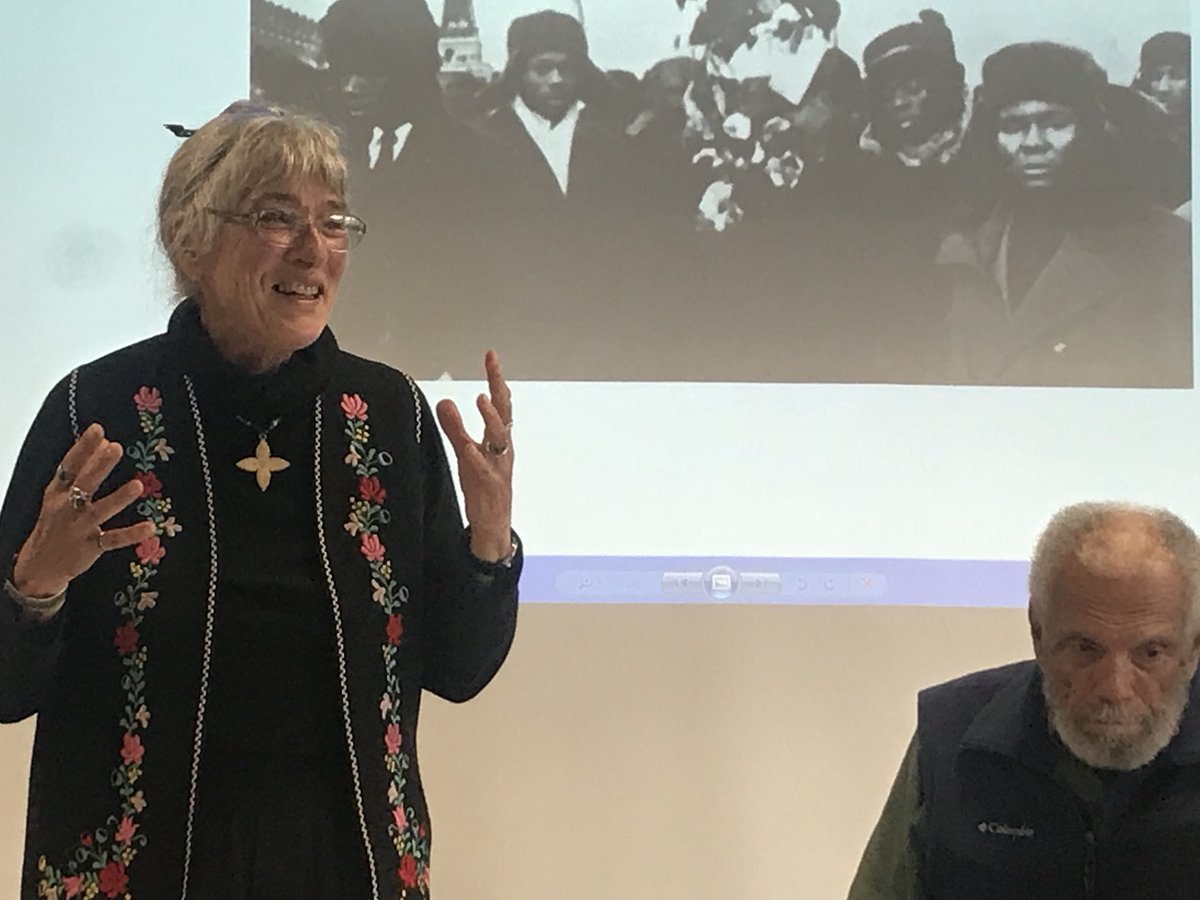
Marika Sherwood speaking at The Red and the Black: The Russian Revolution and the Black Atlantic conference held at UCLAN’s Institute for Black Atlantic Research in 2017
[Personally I owe a great debt to Marika Sherwood, who sadly died at her home in Oare on 16 February 2025 aged 87, as she was a pioneering and legendary researcher of the African diaspora in general and of Black British history in particular – but also incredibly supportive of my own historical work on C.L.R. James and Pan-Africanism and generous in sharing her own personal archive with me. I wrote a short obituary of Marika for Socialist Worker and the Faversham Society newsletter – below is from the latter – and I also had the great honour of publishing her writing on Pan-Africanism both as part of an edited collection arising from the conference The Red and the Black and when helping edit Leeds African Studies Bulletin].
Marika was born in Hungary in 1937 to a Jewish family, many of whom were killed during the Holocaust, experiences which made her into a lifelong opponent of not just antisemitism but all forms of racism and oppression – including that of the Palestinian people. She emigrated with surviving members of her family to Australia in 1948, and lived for periods in New Guinea, New York and Sicily before ultimately making the UK her home.
During the mid-1960s while working as a teacher in London, Marika saw how institutional racism failed young black boys in particular, and was frustrated by the lack of any black history on the school curriculum. While a supplementary schools movement emerged among the West Indian community in response, Marika began what would become a lifetime project campaigning to introduce the black presence in British history onto the curriculum of schools, colleges and universities.
Her weapons in this struggle were a passionate commitment to anti-racist education, tenacious and tireless skills as a dedicated archival researcher, and the methodology of C.L.R. James, Eric Williams and Walter Rodney. She was not alone in this project – one thinks of the work of Peter Fryer, author of Staying Power for example – and soon found allies when in 1991 she co-founded the Black and Asian Studies Association with Hakim Adi and others, becoming editor of its Newsletter.
Her own research expanded from the West Indian contribution in Britain during the Second World War in Many Struggles (1985), to recovering the history of Pan-Africanism in Britain, and then to the wider global dimensions of black history. One notable intervention came with After Abolition: Britain and the Slave Trade Since 1807 (2007), which drew attention to the huge profits that British merchants and bankers still managed to make from slavery and the slave trade until at least the 1880s. Marika’s discussion of what she called ‘the realities behind the well-promoted image of an altruistic and anti-slavery Britain’ powerfully challenged nationalist mythology during the bicentenary of abolition.
Marika’s brilliance shined particularly brightly in her biographical portraits of black fighters, including neglected aspects of the life and work of Kwame Nkrumah, Claudia Jones and Malcolm X. She also made pathbreaking contributions recovering the lives of a host of little-known figures including the Trinidadian Pan-Africanist Henry Sylvester Williams, the Guyanese labour organiser Ernest Bowen and the Nigerian pastor Daniels Ekarte. After moving to Kent she also began inevitably researching local black history in the county. ‘I did it because the people I spoke with seemed to think that there had never been black families living in East Kent, but when I researched it I found people from the colonies had settled in the area since the 16th century’ she later recalled. In 2012 she published Albert Makaula-White, an African Farmer in Kent 1904–1937, following this up with her last work, published earlier this year, An African Family in Kent: The African Makaula-White Family in East Kent.
Her own comradeship with figures like C.L.R. James and Peter Blackman – as well as her own socialist politics, shaped by the Hungarian Revolution of 1956 – meant her writings were passionate and often polemical pieces designed to educate and inspire action. Indeed, and perhaps most remarkably of all, she managed everything with limited institutional support, a senior research fellowship at the Institute of Commonwealth Studies in London. The reputation and respect she established worldwide as a leading authority on Black British History and as a profoundly kind and generous mentor who encouraged and supported so many younger researchers in this field meant she was rightly honoured in 2022 with an honorary doctorate from the University of Chichester.
Marika leaves an extraordinary and inspiring legacy of scholarship and activism – condolences, sympathy and solidarity to her son Craig and her wider family.
Below is a link to the fine memorial event to Marika held at the CLR James Library in Dalston, Hackney in April 2025 – the event starts about 15 minutes in.
 Christian Høgsbjerg - Historian